Procurement notes
Laser Safety Glasses Sourcing Lesson: 'Green' Is Not a Specification
The sourcing decision that looked routine
In January 2024, I was asked to consolidate laser safety eyewear procurement across two of our facilities. At the time, I was managing quality and brand compliance for a metal fabrication company with 11 laser systems spanning five wavelengths—405nm, 445nm, 532nm, 633nm, and 1064nm. About 80 operators needed eye protection, and 14 of them wore prescription lenses under their safety frames.
Before this project, each facility had its own supplier, its own spec codes, and its own interpretation of what "ANSI Z136.1 compliant" meant. Prices ranged from $60 to $240 per pair. Management wanted one vendor, one spec, one process.
I figured this would take three weeks. It took four months, and the lesson stuck with me.
I sent RFQs to six B2B suppliers. The spec I wrote was simple—or so I thought:
- ANSI Z136.1 compliant
- Coverage for 405nm, 445nm, 532nm, 633nm, and 1064nm
- OD rating labeled per wavelength
- Available in both plano and prescription versions
- First order: 220 pairs
Three suppliers responded. I selected one based on two factors: they could supply prescription frames, and we had a small prior order that went smoothly.
When the shipment arrived
The order landed in mid-March—220 pairs in six boxes. I ran our standard receiving inspection. Frames looked solid. Coatings were even. Lens markings were legible. I pulled 22 pairs for lab testing and sent the rest to the floor.
The first four wavelength groups checked out. Then came the 532nm group—our green laser safety glasses.
I asked Sean, one of our laser welders, to try a pair on the 532nm workstation. Sean had been on that machine for 12 years. His eyes are calibrated in a way instruments sometimes miss.
He put the glasses on, looked at the beam path, took them off, put them back on.
"These feel different," he said. "The green comes through brighter than my old pair."
My first instinct was to dismiss it. But Sean is not someone who complains without reason. I grabbed a second operator, and we ran a side-by-side comparison—new pair versus old pair, same laser, same power setting. Both operators could tell the difference in under a minute.
That feeling in my chest was not excitement.
What the spec sheet actually said
I called the vendor's sales rep the same afternoon. The conversation went roughly like this:
Me: "Our spec calls for 532nm OD rating. I need the test data behind your marking."
Rep: "Our orange lens is a standard 520–532nm model. OD 5.2 at 532nm, fully Z136.1 compliant."
Me: "Do you have a third-party test report?"
Rep: "We can provide our internal test records."
The report arrived as a printed Excel sheet. It read: OD @ 532nm = 5.2.
But we had a spectrophotometer in our own lab—one of the perks of doing laser processing in-house. I ran the lens batch at 532nm. The actual optical density was 4.5, not 5.2.
Let me put that in perspective for a 1W 532nm laser:
- OD 5.2 transmits approximately 0.006 mW
- OD 4.5 transmits approximately 0.032 mW
Both figures sit below the maximum permissible exposure for that wavelength. But the gap between them is a factor of five. And under EN 207, 532nm protection is defined by pulse duration and power density—not by a single OD number pulled from a neighboring wavelength.
The root cause was a 12nm gap. The vendor's "standard model" was tested at 520nm and extrapolated to 532nm. A lot of suppliers group 520 and 532 together. The coating performance at those two wavelengths is not the same.
(I should mention: what most people don't realize is that this 520/532 grouping is common across the industry. It's not fraud. It's a tolerance convention that has never been formally standardized.)
What we uncovered after pulling the thread
The more we dug, the more the problem widened.
Sean's old glasses—the ones we had been using for four years—were a 520nm model. That means our original specification had the same mismatch. Nobody had ever tested it. The only reason we caught it now was a routine receiving inspection that happened to include a wavelength-specific check.
I pulled the full procurement history and found one more issue: a batch of 445nm blue laser safety glasses had been issued to a workstation running a 405nm diode. Again, adjacent-wavelength extrapolation. Again, nobody had compared the lens marking to the actual laser source.
Three patterns emerged:
- "ANSI Z136.1 compliant" is not a specification. It is a framework. The standard requires appropriate OD for the specific wavelength, power, beam diameter, and exposure duration. A contract needs those numbers written out—not a compliance statement.
- "Multi-wavelength coverage" and "tested at every wavelength" are different claims. Catalog coverage often means interpolation from nearby wavelengths. Unless a test report exists for the exact wavelength, the OD value is an estimate.
- Prescription laser safety glasses need separate validation. Prescription lens curvature and thickness change transmission characteristics. From that point forward, we required wavelength-specific test data for every prescription SKU, not just the plano version.
I should add that our internal process had its own gaps. The old frames had been in service since 2020 without a wavelength cross-check against our updated laser inventory. That was on us, not the vendor.
What changed in our sourcing process
We rejected 60 pairs from that shipment—the full 532nm group. The vendor redid the batch at their cost, this time with lenses that tested at OD 5.5 on our spectrophotometer. The replacement arrived in late April. Total delay: three weeks. No injuries, no near-misses.
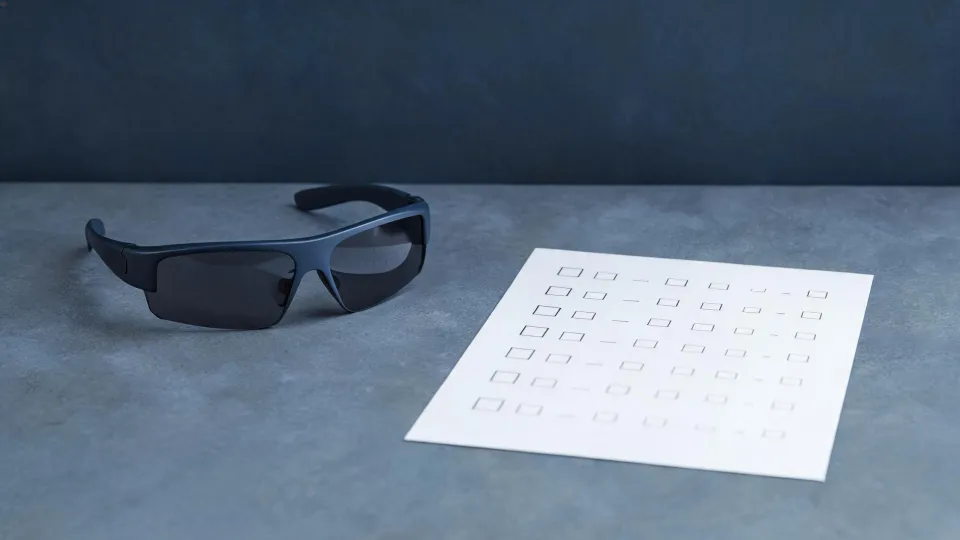
But the purchasing spec changed permanently. Here is what our laser safety glasses sourcing document now requires:
- Minimum OD value listed separately for each wavelength in the contract
- Third-party test reports (internal Excel sheets are not accepted)
- Separate test reports for prescription versions of every SKU
- A contract clause stating that orders without test documentation are returnable
- A biennial reconciliation between active laser wavelengths and issued lens models
I consolidated these into a one-page checklist that we now use for all laser safety eyewear procurement—red, green, blue, UV, IR, and prescription.
To be fair, the vendor's frame quality was excellent. We still buy their frames. We just write the lens spec ourselves now.
If I had to compress the entire experience into two sentences for someone sourcing laser safety glasses: write the OD value in the contract, not the word "compliant." Write the wavelength in nanometers, not the color name.
Because "green" is not a specification. And in laser safety, a 12nm gap is the difference between a compliant shipment and a rejected one.

I’m Jane Smith, a senior content writer with over 15 years of experience in the packaging and printing industry. I specialize in writing about the latest trends, technologies, and best practices in packaging design, sustainability, and printing techniques. My goal is to help businesses understand complex printing processes and design solutions that enhance both product packaging and brand visibility.